Abstract
When and how did the medieval Chinese aristocracy decline? Generations of historians have argued that the political power of the aristocracy was gradually displaced by the imperial examination system (Keju) during the Tang dynasty. Some historians, on the other hand, have tried to challenge this long-established consensus by alleging that aristocratic political dominance persisted until the Huang Chao Rebellion at the end of the Tang, pointing to the ostensibly stable share of aristocrats among high ranking officials across the dynasty. This article identifies several fundamental flaws in the statistical reasoning underlying claims of aristocratic persistence, including conceptual ambiguity, definitional tautology, misinterpretation of conditional probabilities, and the absence of control variables in existing quantitative analyses. Using multivariate statistical models applied to a large sample of Tang tomb epitaphs, drawn from essentially the same epitaph based evidence used in prior quantitative studies but analyzed with more adequate methods, I show that the political advantage associated with aristocratic pedigree declined rapidly after the early Tang, while the net premium associated with Keju credentials increased steadily over time, even after controlling for aristocratic influence. Both trends—the erosion of pedigree-based advantage and the rising importance of Keju—were already underway more than two centuries before the Huang Chao Rebellion and other violent upheavals marking the end of the Tang and its immediate successor polities. These new findings leave the social and political dimensions of the Tang-Song Transition thesis on shaky ground.
This article is an English translation of a study previously published in Historical Research (历史研究), with minor adaptations for an English-language audience. The original Chinese version appeared as:
从唐代士族衰亡看史学量化范式的科学使用,《历史研究》2025年第6期,第165-187,192页
Keywords: Tang Dynasty; medieval Chinese aristocracy; Chinese imperial examination system (Keju); social mobility; Tang-Song Transition; Quantitative history
Introduction
The rise and fall of the aristocracy has long been a foundational subject in the study of medieval China,1 serving as a key thread for exploring the political, social, and institutional transformations of that historical era.2 In recent years, however, scholarly attention to the aristocracy has declined, and research progress has reached an intellectual impasse.3 Fan Zhaofei, in his discussion of extant studies that employ case-study methods to understand aristocratic families, urges scholars of aristocracy to focus more on the “big questions” and to ensure their findings can be generalizable for the study of “aristocracy as a group.” He keenly notes that the vast body of case studies on aristocracy over the past decades all claim to be “representative,”4 implying that even research paradigms focusing on individual families ultimately aim to uncover macro group-level trends. Qiu Luming underscores the importance of the Tang Dynasty (618-907 CE), suggesting that, from the perspective of social and institutional transformation, the fate of the medieval Chinese aristocracy during the Tang Dynasty provides a good case for testing, refining, and further developing historical theory. Situated between the Wei, Jin, and the North and South Dynasties (220-589 CE)—often characterized by a semi-hereditary or noble system—and the Song Dynasty (960-1279 CE), in which the imperial examination system (Keju) is believed to be paramount, the Tang Dynasty forms a transitional period from aristocracy to bureaucracy. He argues that “further empirical research is needed” to pin down what actually happened during this transitional period, from the perspective of bureaucratic career outcomes.5
It is worth noting that these scholars’ emphasis on representativeness, typicality, and group-level trends in empirical inquiry has, in most instances, been pursued in past studies through a “quantitative” paradigm.6 Scholars such as Sun Guodong, David G. Johnson, Mao Hanguang, and Nicolas Tackett have conducted statistical analyses of the bureaucratic careers of Tang aristocrats, seeking thereby to explore broader patterns concerning social stratification and mobility in medieval China.7 As focusing on group-level trends and macrohistorical trajectories is crucial for advancing the frontiers of the literature on the medieval Chinese aristocracy, it is important to revisit the application of quantitative paradigms to the study of the aristocracy’s decline. Patterns of social mobility and shifts in the relative power of social groups are fundamental to macro-historical transformations. Statistical analysis is therefore indispensable, as it offers an effective means of tracing long-term trends in class structure.8 After all, discussions of the aristocracy and other broader historical issues inevitably involve the examination of “groups,” hence the use of statistical methods.
Regarding the long-debated question of the decline and fall of the medieval Chinese aristocracy, a reexamination of the statistical approaches previously employed in the historical literature is essential. The “chronic decline school” argues that, as the Keju system consolidated during the Tang dynasty, the aristocracy gradually lost its privileges in both bureaucratic entry and advancement. Social perceptions of what constituted a prestigious family background also shifted, paving the way for the political rise of new social groups.9 By contrast, the “persistence school” relies on statistical tabulations, calculating the proportion of high-ranking officials, such as chief ministers (宰相), who were of aristocratic origin across different periods of the Tang dynasty. They find that this proportion remained largely stable from the early to the late Tang. On this basis, they allege that the aristocracy’s political status did not diminish during the Tang and that the Keju system failed to challenge its position. According to this view, the aristocracy did not decline until the Huang Chao Rebellion (ca. 880 CE) in the late Tang and the subsequent wars of the Five Dynasties (907 - 960 CE), when it perished abruptly rather than gradually.10
As the foregoing discussion suggests, although scholarly interest in long-standing canonical questions such as the rise and fall of social classes has waned in recent years in the study of medieval Chinese history, this shift does not imply that consensus has been reached. The debate over the decline of the medieval Chinese aristocracy remains largely unresolved. Competing schools of thought continue to advance fundamentally opposed arguments, and no definitive conclusion has yet emerged. In this sense, the fall of the aristocracy remains understudied, leaving substantial room for further scholarly inquiry.
One important reason for this persistent disagreement seems to lie in methodological differences. The “persistence school” derives its conclusions primarily from statistical evidence, whereas the “chronic decline school” places greater emphasis on qualitative analyses of cases, texts, and institutions. If the disagreement stems from how quantitative evidence is used rather than from the evidence itself, a closer examination of the specific statistical approaches employed by the “persistence school” can therefore help reassess the validity of its claims and clarify the sources of disagreement.
Although the past several decades have witnessed rapid advancements in statistical science, the use of statistical methods in historical research, especially by the “persistence school,” has remained highly rudimentary. This study demonstrates, in a systematic way, that the “persistence school” suffers from serious methodological flaws. This is not the fault of the quantitative paradigm itself, but rather the result of its incorrect and inadequate application by the “persistence school.” By employing modern tools of applied statistics, this study addresses fallacies that arise from misuse rather than from any limitations of the quantitative paradigm itself.
Drawing on multivariate statistical models built from Tang-dynasty tomb epitaphs, which provide a more representative sample of Tang society than other prosopographical sources, the analysis shows that the political advantages associated with aristocratic pedigree had already begun to diminish after the early Tang, rather than persisting unchanged until the final decades of the dynasty. Meanwhile, the importance of one’s immediate forebears (defined here as father and grandfather) remained constant. At the same time, even after controlling for aristocratic participation in the imperial examination system, the independent effect of the examinations on social mobility continued to strengthen over time, ultimately becoming an effective channel through which new families of humble origin could rise in status. In short, the medieval Chinese aristocracy had long been in decline well before the Huang Chao Rebellion, and the examination system had likewise already become a dominant force well before that late-Tang upheaval.11
The Challenges of Quantification in the Study of the Aristocracy’s Decline
Existing quantitative studies of the medieval Chinese aristocracy suffer from three major problems: ambiguous definition (thus leading to false positives), misinterpretation of statistical quantities of interest, and conflation of different dimensions of family background.
Conceptual Ambiguity, Self-Contradiction, and Tautology in the Definitions of Aristocracy Employed by the Persistence School
Previous statistical analyses typically rely on calculating the proportion of high-ranking officials in the Tang Dynasty who hailed from aristocratic families, an approach apparently entailing a clear definition of the aristocracy. Yet the definitions in many of these studies tend to be vague, insufficiently specified, and at times even self-contradictory.
Take Mao Hanguang’s Historical Research on Medieval Chinese Society as an example. Mao’s definition of aristocratic families includes “those whose members held government positions at Rank Five or above in two out of three generations,” yet he fails to explain whether the term “three generations” refers to the line extending to the great-grandfather (i.e., father, grandfather, and great-grandfather) or refers to the line including the individual himself (i.e., himself, father, and grandfather). Elsewhere in the same work, Mao emphasizes that official dynastic histories generally record only the names, titles, and office ranks of an individual’s father and grandfather, sometimes the great-grandfather, while rarely including the great-great-grandfather. Hence, he argues that “if one were to restrict aristocratic status to families traceable through four or five generations, those lacking recorded information on grandfather, great-grandfather (emphasis mine), or earlier forebears would be excluded, which is apparently unreasonable; adopting ‘three generations’ as the standard aristocratic definition is therefore a workaround for the limitations of available sources.” This statement essentially argues that, because of source limitations, one should not include the great-grandfather when assessing whether two out of “three generations” held government positions at or above Rank Five. If the great-grandfather (and anyone above him) is excluded from the count, then the “three generations” must consist of the individual himself, his father, and his grandfather, since only these three remain. In other words, Mao’s reasoning implies that “three generations” refers not to the lineage extending backward to the great-grandfather but instead to the individual, his father, and his grandfather. Incorporating an individual’s own bureaucratic career into the definition of family pedigree, however, violates the basic principle of social mobility research and introduces the peril of reverse causality from the outset - hypothetically speaking, an individual attaining high office with his own effort would be likely seen as evidence of family help because his own achievement is now being used, by Mao, for defining aristocratic family background.12 Mao’s definition also lacks internal consistency. As he states elsewhere, “families in which either one’s father or grandfather held a Rank-Five-or-above office should be classified as ‘minor elites’ (not aristocrats).” This implies that if only one out of these two immediate generations attained Rank Five or above, the individual himself would not qualify as an “aristocrat.” Yet if Mao’s earlier definition of “three generations” is meant to include the individual himself, his father, and his grandfather, then any individual who, together with either his father or his grandfather, held a government position at Rank Five or above would meet Mao’s criterion of “two out of three generations” and should therefore be counted as an aristocrat rather than a “minor elite.” This contradiction exposes the definitional inconsistency at the core of Mao’s framework. An even more explicit inconsistency appears elsewhere in Mao’s work, where he argues that families in which “two out of three generations among the father, grandfather, and great-grandfather had served as governor (刺史), prefect (太守), or two-thousand-bushel official (二千石)” should be regarded as aristocratic.13 This definition not only contradicts his earlier exclusion of the great-grandfather when specifying “three generations,” but is also incompatible with his categorization that “families in which only one of the father or grandfather reached Rank Five or above are ‘minor elites.’” By Mao’s own “two prominent generations out of three” standard, a lineage in which the father and great-grandfather held high-ranking offices while the grandfather did not should still qualify as aristocratic. Yet according to his other criterion, such a family would instead be classified as “minor elites.”
Mao’s work also arbitrarily expands the scope of “aristocracy” by claiming that many “prestigious clans” mentioned in historical records should likewise be classified as aristocratic families, even if they do not meet the aforementioned criteria. At this point, his definition becomes even more nebulous, as he employs a diverse array of loosely specified words, including “all those whom the histories refer to as prestigious clans,” “the prominent choronym-surname (郡姓),14 the Sarbi-associated choronym-surname (虏姓), and the southern aristocratic surname (吴姓) mentioned by Liu Fang (柳芳),” “the prominent clans recorded in the official histories,” “the old aristocratic families,” “the old lineages of the Wei-Jin Dynasties,” and “the prominent surnames at the prefectural level,” etc.15 Mao never clarifies which specific families, branches (房支), or choronym-surname combinations these terms actually encompass. Since the concepts underlying these words are quite broad, applying quantitative methods without clarified criteria risks rendering the “aristocracy” an arbitrary and overly expansive category, thereby inflating the calculated proportion of aristocrats among high-ranking officials. Historical research that employs statistical analysis must therefore avoid such definitional ambiguity and self-contradiction when identifying the aristocracy.
Nicolas Tackett, for his part, does not begin with an a priori definition of the aristocracy. Instead, he adopts a data-driven approach, seeking to identify what groups actually belonged to the most prominent social stratum as perceived by Tang contemporaries.16 Drawing on a large corpus of tomb epitaphs and transmitted textual sources, he reconstructs marriage networks among Tang elite families and identifies a cluster of families, buried in Chang’an, Luoyang (the two Tang capitals), and the “capital corridor” between them, that were tightly intermarried, forming an extensive elite marriage network.17 The Destruction of the Medieval Chinese Aristocracy (hereafter Destruction) represents the first attempt to reconstruct this network and relies primarily on ninth-century epitaphs. Tackett (2020) updates the research in Destruction, using tomb epitaphs and transmitted textual sources spanning the entire Tang dynasty, and shows that this networked structure persisted from the seventh century through the late ninth century.18 Its members, he argues, constituted the most socially eminent individuals of the period. In Destruction and subsequent studies, Tackett further contends that membership in this marriage network conferred significant advantages in officeholding, enabling this elite group to maintain political dominance across generations.
Although Tackett employs a novel, data-driven approach to defining the aristocracy, namely treating all members of the twin-capital marriage network as aristocrats, his method for evaluating the rise and fall of the aristocracy is essentially identical to the conventional statistical analyses of Sun Guodong, David Johnson, Mao Hanguang (critiqued above), among others. Specifically, existing quantitative studies all rely on calculating the proportion of aristocrats (under researchers’ varying definitions of the aristocracy) among high-ranking Tang officials and examining how this ratio changed over time. Given the finding that the proportion of chief ministers drawn from the twin-capital elite marriage network remained high throughout the Tang dynasty, Tackett concludes that neither the Keju system nor other major social and institutional transformations in the Tang Dynasty significantly challenged the aristocracy’s political dominance.
However, the problem of circular reasoning in calculating that proportion is built into Tackett’s very definition of the aristocracy. In constructing the elite marriage network, any individual who intermarried with a network member is treated as part of the network, regardless of whether the marital connection was formed by one’s ancestors, by the individual himself and his contemporaries, or by his descendants. Once such a connection is established, both the forebears and descendants of that individual are automatically regarded as members of the twin-capital elite marriage network, that is, classified as “aristocrats” under Tackett’s definition.19 This implies that even a man of humble origin—one who, in the words of Tang observers, “rose by talent rather than pedigree”20—would be, once absorbed into the marriage network after achieving success in his bureaucratic career, automatically classified as an aristocrat. In Tackett’s statistical analysis, such individuals are automatically counted as part of the aristocratic proportion among high-ranking officials, thereby supporting his claim that the aristocracy succeeded “in monopolizing top positions in the bureaucracy until the very end of the dynasty.”21
In other words, when a man from a humble family with no prior marital connection to the network rises in the bureaucratic system by virtue of factors like talent or Keju success, and subsequently marries a woman from the network (or when his descendants do so thanks to his high political position), Tackett classifies him as an elite network member and treats all of his ancestors as if they had always belonged to this network. Thus, even when his career advancement has nothing to do with the twin-capital elite network, he is retroactively defined as having an aristocratic pedigree. A calculation of the “aristocratic proportion among chief ministers” based on such a definition is therefore bound to conflate “his success made him an aristocrat” with “his aristocratic background made him successful,” resulting in a circular reasoning problem.
In fact, if one modifies Tackett’s classification rule such that an individual is counted as an aristocrat only when the generations of his father and above already belonged to the twin-capital marriage network, then as many as 25.41% of the chief ministers whom Tackett previously identifies as aristocratic are actually of humble origin (e.g., Zhang Jiuling 张九龄, Zhang Yue 张说, Miao Jinqing 苗晋卿, Zhang Jiazhen 张嘉珍, Niu Sengru 牛僧孺). A statistical practice that retroactively incorporates later marital connections into one’s ancestral pedigree thereby infers aristocratic status from bureaucratic career success, giving rise to circular reasoning that severely inflates the proportion of aristocrats among Tang chief ministers.
Misunderstanding Conditional Probability when Studying Social Mobility and the Aristocracy
Although the “persistence school” relies primarily on statistics, the quantities it focuses on are fundamentally inadequate for addressing questions about the aristocratic career advantages or broader patterns of social mobility. Social mobility is a concept rooted in the social sciences. While studies may differ in their choice of variables and methods, they all focus on the statistical association between “origin” and “destination,” estimating the career advantage conferred by a privileged family background by comparing the occupational achievement of individuals from “advantaged” versus “ordinary” families. Formally, this can be expressed as E (destination | advantaged origin) − E (destination ∣ ordinary origin), i.e., the difference in average career outcomes between those with privileged backgrounds and those without. Holding other factors constant, the larger this difference, the greater the advantage conferred by privileged origin, and the lower the degree of social mobility; and vice versa.
It follows that empirical research on social mobility must include individuals from different family origins and with varying career outcomes. Applying such an estimation framework to assess aristocratic advantage in bureaucratic career yields an analogous statistic: E (office rank ∣ aristocrat) − E (office rank ∣ non-aristocrat), i.e., the difference in expected bureaucratic career outcome between those from aristocratic and humble families. When the focus shifts to holding high office as a marker of achievement, this difference-in-means statistic transforms into a conditional probability expression: P ( high office | aristocrat) − P ( high office ∣ non-aristocrat), i.e., the difference in the probability of attaining high office between individuals with aristocratic and humble origins. Temporal changes in this gap allow us to assess the level of social mobility across different periods of the Tang Dynasty. A large gap indicates a strong aristocratic advantage in officeholding and thus lower social mobility, and vice versa. This statistical formulation closely aligns with our intuitive understanding of social mobility: How much career advantage in bureaucracy does being “born into” a privileged family confer over being “born into” an ordinary one? The difference in conditional expectations or conditional probabilities constitutes the statistical expression of the question.
The “persistence school” explicitly claims to be concerned with issues of “social mobility” and aristocratic “advantage” in officeholding,22 yet the statistical measure it focuses on is merely the proportion of high-ranking officials from aristocratic families, i.e., P (aristocrat ∣ high office), rather than the difference in the probability of attaining high office between aristocrats and non-aristocrats. As a result, the methodology employed by the “persistence school” is fundamentally incapable of answering questions about social mobility or aristocratic career advantage in bureaucracy.
Importantly, this misunderstanding of conditional probabilities leads the “persistence school” to draw conclusions that not only diverge from the evidence but in some cases are the exact opposite of what the data actually suggest. Specifically, the “persistence school” observes that the proportion of aristocrats among high-ranking officials, P (aristocrat ∣ high office), remains roughly constant (around 70%) across different periods from the early to the late Tang, thereby alleging that the aristocratic advantage in officeholding exhibited no significant decline throughout the dynasty and that the level of social mobility remained consistently low.23
The statistical pitfall in this reasoning is the failure to account for differential fertility, that is, changes over time in the relative population sizes of aristocrats and non-aristocrats. Basic demographic reasoning indicates that the offspring survival rate of privileged classes in historical times was substantially higher than that of non-privileged classes,24 while population growth across generations is exponential. By the logic of the “persistence school,” the aristocracy, holding such a high share of early Tang chief ministers, must have been a highly privileged class whose offspring should therefore have had a survival rate far exceeding that of those from humble backgrounds. Even under a conservative assumption that aristocrats enjoyed only a 25 percent survival-rate advantage per generation, the population ratio of aristocrats to non-aristocrats would have grown by nearly five times its original size from the early to the late Tang. Under a more generous assumption of a 100 percent survival-rate advantage per generation, meaning a doubling, this ratio would have expanded by roughly 255 times.25 Yet despite such explosive growth in the underlying aristocratic population relative to non-aristocrats, the proportion of high-ranking officials from aristocratic families remains essentially unchanged at about 70%. When set against the dramatic demographic expansion implied by their own assumptions, this apparent stability in the aristocratic share among high-ranking officials in fact signals a substantial decline in individual-level aristocratic advantage.
In sum, although the share of aristocrats among high-ranking officials remained relatively stable throughout the Tang dynasty, this surface stability masks the high likelihood that the aristocratic population base expanded by multiple orders of magnitude relative to the non-aristocratic population. If so, then the individual officeholding advantage of each aristocrat—measured as the difference between the share of aristocrats attaining high office and the corresponding share among non-aristocrats—would necessarily have diminished over time.26 From this perspective, statistical patterns that appear to show a persistent aristocratic advantage in fact point to substantial social mobility. Properly assessing aristocratic advantage using quantitative methods therefore requires estimating it directly from the sample as the difference P(high office | aristocrat) minus P(high office | non-aristocrat), and tracing how this gap evolves across periods. Only such an approach can avoid the statistical pitfalls created by conflating conditional probabilities.
Oversimplifying the Concept of Aristocracy: Conflating Ancestral Pedigree and Recent Forebears
The third problem in existing quantitative studies is the oversimplification of the concept of aristocracy, most notably through the conflation of two analytically distinct dimensions of family background: “ancestral pedigree” (门第, understood as long-run lineage prestige) and “recent forebears” (近祖, understood as short-term familial power). In practice, these two dimensions carried different meanings and operated through different mechanisms across historical contexts. For instance, the “contest between men of humble background and the sons of powerful families” (孤寒与子弟之争), a well-known phenomenon during mid-to-late Tang Dynasty (circa ninth century), underscores the political significance of one’s recent forebears, and even of offices held by contemporaneous kin, rather than distant lineage.27 By contrast, the late Northern Dynasties (386 - 581 CE)’ emphasis on the “old clans of the Han-Wei period (202 BCE - 265 CE) (汉魏旧族)” reflects the enduring political salience of remote ancestral pedigree.28
Evidence drawn from prominent Tang office-holding families further illustrates the necessity of distinguishing between these two dimensions. On the one hand, figures such as Wei Chengqing (韦承庆), Wei Sili (韦嗣立), and Li Deyu (李德裕) possessed family backgrounds that combined illustrious ancient pedigrees with powerful recent forebears. On the other hand, officials from newly risen families, such as Zhang Hongjing (张弘靖) and Gui Renhui (归仁晦), were by no means uncommon, even though they lacked a distinguished remote pedigree due to the obscurity of their distant ancestors.29 These contrasting patterns make clear that a more accurate understanding of aristocratic advantage in officeholding, as well as how patterns of social mobility evolved over time, entails examining the distinct roles played by ancestral pedigree and recent forebears rather than collapsing them into a single, undifferentiated notion of “aristocratic origin.”
Yet scholars such as Mao Hanguang and Nicolas Tackett rely on a single dimension when operationalizing the aristocracy in their quantitative analyses. This approach reduces a historically complex and multidimensional concept to an overly simplified, expansive category, thereby grouping together individuals with fundamentally different backgrounds. Mao, for instance, classifies not only the Lu of Fanyang (范阳卢氏)—a renowned lineage traceable to the Han-Wei period—as “aristocratic,” but also families such as the Erzhu clan (尔朱氏), who rose to prominence as powerful military actors after the Six Frontier Garrisons Rebellion (524 CE), and the Hulu clan (斛 律氏), military elites of Chillek (敕勒) origin who peaked under the Northern Qi (550 - 577 CE).30 Tackett’s operationalization of the Tang aristocracy, based on membership in the twin-capital elite marriage network, produces a parallel conflation: it collapses historically entrenched houses such as the “Five Surnames and Seven Clans” and the families of Hebei provincial military commissioners (节度使) who rose out of the An Lushan Rebellion into a single analytical category, effectively conflating ancient pedigree with contingent political ascent simply on the grounds that both sets of families had intermarried with the Tang imperial household and thus appear within the same network.31
Aristocratic “Advantage” in the Imperial Examination System?
The Chinese imperial examination system (科举, Keju) constitutes one of the central issues in scholarly debates over the decline of the medieval Chinese aristocracy. Scholars who argue that the aristocracy maintained its dominant position throughout the Tang have therefore frequently emphasized aristocratic advantages in Keju competition. Existing studies typically allege that the overwhelming majority of successful examinees (especially Jinshi, to be discussed next) came from “aristocratic” families by simply tabulating their family backgrounds recorded in Dengke Jikao (Research on the Rosters of Tang Examination Graduates, 《登科记考》) or the Old Book of Tang (《旧唐书》) and New Book of Tang (《新唐书》).32
However, the problem with calculating the proportion of aristocrats from any “roster” of exam passers is that complete Tang government rosters simply do not exist today. Historians therefore had to use severely incomplete “lists” for such calculations. Surviving Tang historical sources preserve only extremely fragmentary evidence on the names of those who passed the highest level of the examination, hereafter referred to as Jinshi. The total number of Jinshi admitted during the Tang dynasty is approximately 6,585. Yet even after the extensive emendations to the so-called “Research on the Rosters of Tang Examination Graduates” (Dengke Jikao) undertaken by generations of historians, the reconstructed rosters of Tang Jinshi altogether still account for less than 38.86% of the grand total, among which cases with clearly documented family background information are rarer still.33 Under such conditions, only families with more prominent backgrounds—and hence aristocrats—were likely to leave surviving records. Any attempt to calculate the proportion of aristocrats from such highly incomplete “lists” is therefore plagued by severe selection bias in favor of aristocratic dominance.
As the importance of the Keju increased during the Tang dynasty, the Old Book of Tang often appended information on the examination success of officials’ descendants to the biographies of prominent officeholders. Since these individuals were descendants of prominent officials, any who passed the examination were automatically treated as “aristocrats” by historians and counted toward the aristocratic share among identifiable examination passers.
The Yang clan provides a clear illustration. Figures such as Yang Ji (杨技), Yang Shi (杨拭), Yang Wei (杨㧑), Yang Zhuo (杨擢), Yang Zheng (杨拯), Yang Ju (杨据), Yang Kui (杨揆), Yang Zhuo (杨拙), and Yang Zhen (杨振) left no notable political achievements of their own. Their examination success is known to later generations solely because they were grandsons of the eminent official Yang Yuling (杨於陵).34 Their names leave traces in history only because they were appended to the Old Book of Tang biography of Yang Yuling and his sons. For these men, passing the Keju was among the very few life events considered worthy of historical record.
As a result, successful candidates descended from prominent officials were disproportionately visible in the surviving sources and were automatically incorporated—under the label of “aristocrats”—into calculations of the aristocratic share among identifiable examination passers by historians.
By contrast, officials who did not rise to the level of prominent officeholders were generally not selected as subjects of biographical entries in dynastic histories such as the Old Book of Tang. Even if their descendants succeeded in the Keju, those descendants could not, as in the Yang family discussed above, be recorded as offspring of a biographical subject.
For instance, although figures such as Chen Jie (陈皆), Kang [given name unknown] (康某), Yu Congzhou (余从 周), and He Yong (何邕) all secured government positions through Keju and attained offices higher than those held by their fathers and grandfathers, their exam success went unrecorded in the dynastic histories due to a lack of distinguished recent forebears, who were not eligible for a biographical entry in such histories. Absent evidence from excavated tomb epitaphs, these men of humble background might never appear in any extant Keju “roster.”35
Given the current state of historical materials excavation and utilization, biographical entries in the official dynastic histories remain the primary source of family-background information for such already highly incomplete lists of successful examination candidates. Calculating the proportions of aristocrats and non-aristocrats from such lists or rosters is therefore highly likely to overestimate the aristocratic share and underestimate the non-aristocratic representation. From the epitaph-only dataset employed for this study, if aristocrats are defined as individuals whose father and grandfather both held offices at Rank Five or above, only 25.2% of successful Keju candidates qualify as aristocratic. Even when aristocrats are defined more expansively as those traceable to prominent branches, their share among successful candidates rises only to 39.4%, well below estimates exceeding 70 percent in the existing literature.36
If one seeks to rigorously estimate the impact of Keju on social mobility in the Tang Dynasty, the use of control variables is more imperative than ever. Existing studies primarily rely on calculating percentages for a single variable, a form of simple descriptive statistics that is ill-suited to capturing complex historical circumstances. On issues concerning social mobility and institutional change, multiple forces operate simultaneously and interact with one another. Therefore, estimating the effect of any single force requires the use of modern statistical methods—multivariate statistical modeling—in which “control variables” are employed to isolate the influence of competing forces.37
At the core of scholarly debates over the decline of the medieval Chinese aristocracy lies the role of the Keju during the Tang dynasty. The “persistence school” denies that Keju had meaningful implications for upward mobility. Their argument rests largely on the observation that aristocrats constitute a substantial share of the surviving Jinshi rosters, an approach that has been debunked above. They also use selective historical accounts of favoritism and clientelism within the examination system.38 On this basis, they allege that aristocratic families effectively monopolized access to Keju success. Yet sources from the mid- and late Tang also document institutional restrictions on, and at times active suppression of, aristocratic participation in the examinations.39 Simply juxtaposing selectively chosen historical anecdotes with “statistical” tabulations that are themselves heavily affected by selection bias cannot meaningfully estimate either the magnitude of aristocratic advantage in Keju or its broader impact on social mobility. In the Tang context—where entrenched pedigree hierarchies coexisted with newly institutionalized mechanisms of elite recruitment, and where aristocratic participation in Keju was widespread—assessing whether and to what extent Keju facilitated upward mobility for men of humble background requires carefully structured comparison analyses employing control variables. Without such an approach, scholars risk mistaking artifacts of the sources for actual historical patterns.
For example, Cui Gong (崔珙) of the second branch of the Cui of Boling (博陵崔氏) enjoyed a prominent pedigree, passed the “decree examination (制举),”40 and eventually rose to the position of chief minister during the reign of Emperor Wuzong (唐武宗), while also having served as a provincial military commissioner.41 He thus represents a group of officials who combined eminent family background with examination success and ultimately attained distinguished bureaucratic careers. This raises a natural question: among the factors contributing to the success of such individuals, which carried greater weight—family pedigree or success in Keju? Some scholars might argue that a privileged family background was what ultimately explained both examination success and later bureaucratic achievement, implying that the role of Keju here might have been spurious. Yet this view may substantially underestimate the independent role of Keju. After all, within the same historical period, one can readily identify figures such as Cui Xinggui (崔行规) of the first branch of the Cui of Qinghe (清河崔氏), who likewise possessed a prominent pedigree but lacked examination credentials and ended up with an undistinguished official career.42 By comparing Cui Gong and Cui Xinggui—two individuals who share a similar family background but differ in Keju attainment—we observe a striking divergence in bureaucratic career achievement, suggesting the independent significance of Keju beyond pedigree alone.
Additional evidence comes from figures such as Zhang Yue (张说) and Yang Shou (杨收), who, despite lacking distinguished family backgrounds, succeeded in the examination and rose to the rank of chief minister, achieving careers comparable to that of the far more pedigreed Cui Gong. Conversely, Liu Bin (刘斌), a man likewise came from an undistinguished family but failed to secure examination success, saw his career stall at the level of county commandant in Wucheng. In contrast to Liu’s stalled career, the two chief ministers also of humble origin—Zhang and Yang—vividly illustrate the importance of examination success for advancement within the bureaucracy.43
If success in Keju and family background are treated as two “independent variables,” and bureaucratic career outcome as the “dependent variable,” then the foregoing discussions, approximating grouped and paired comparisons, illustrates how holding one variable constant allows us to observe the effect of variation in the other on the dependent variable.
The above examples serve only as a simplified illustration of the logic underlying the use of control variables. Rigorous quantitative analysis using control variables requires statistical models and large-sample data, rather than through illustrative case comparisons alone. The factors shaping bureaucratic careers are numerous, and their effects vary across historical periods. Fully accounting for the multiple configurations and interactions among these factors requires huge numbers of permutations and combinations, something that can only be achieved with large samples. Large-sample analysis helps avoid the risk of overgeneralization inherent in illustrative examples, since “counterexamples” can always be found. Parameter estimates in multivariate statistical models, by contrast, summarize the balance of evidence in the data by quantifying the relative strength of confirming cases and counterexamples.44
Overall, multivariate statistical modeling provides an effective tool for assessing institutions and institutional change in a complex historical context. In periods when aristocrats constituted a substantial share of high-ranking officials, determining the extent to which Keju itself mattered requires rigorous empirical analysis. Such an approach, in turn, depends on controlling for variables such as “aristocratic origin” to isolate the effect of Keju on bureaucratic entrance and advancement from other confounding factors.
Tomb Epitaph Dataset and Statistical Modeling
The primary dataset used for this study is built on version 1.5 of the Prosopographic and Social Network Database of the Tang and Five Dynasties (TBDB), released by Nicolas Tackett in 2020.45 This database integrates transmitted textual sources, such as the Old Book of Tang and New Book of Tang, with biographical information extracted from 5,608 tomb epitaphs of individuals active during the Tang, thereby serving as a comprehensive supplement to the dataset originally constructed in Destruction. For this study, only male tomb epitaphs are included, and the sample is further restricted to individuals who died during the Tang Dynasty (618-907). After data cleaning, the main dataset consists of 3,640 tomb epitaphs of male elites.46 Compared with transmitted textual sources, tomb epitaphs are better suited for large sample analyses of group level trends. Their advantage lies not only in the more detailed recording of bureaucratic careers but also in their relatively high representativeness. Because tomb epitaphs are excavated in a quasi random manner, those unearthed across different regions of China can be treated as a less biased sample of Tang elite society within each region of burial than the dynastic histories. As a result, individuals who attained only mid or lower level offices, as well as those who never entered officialdom, appear far more frequently in tomb epitaph samples, since their low bureaucratic rank often precluded detailed documentation in transmitted textual sources.47
I contribute two original extensions to Tackett’s database. First, for each of the 3,640 tomb epitaphs in the sample, I assign the formal bureaucratic rank to the office held by the epitaphee at the end of his career, as well as to those held by his father and grandfather. The assignment of numeric ranks draws on the relevant sections or pages of the Old Book of Tang, New Book of Tang, as well as the Book of Wei (《魏书》), Comprehensive Statutes (《通典》), and Book of Sui (《隋书》), all of which contain descriptions of offices and their corresponding ranks. The inclusion of the latter three sources is necessary because the fathers and grandfathers of some epitaphees during early Tang had served in government positions under the Northern Dynasties, Southern Dynasties (420 - 589 CE), or the Sui Dynasty (581 - 618 CE).
Second, because the formal office rank was closely associated with the legal privileges stipulated in Tang law, it serves as a reasonable proxy for distinguishing among officials in their treatment.48 At the same time, the Tang Dynasty was a period when the bureaucratic system gradually shifted toward a regime of delegated commission (使 职), such that an official’s actual power did not necessarily correspond entirely to his formal rank. To ensure the robustness of the empirical results and to capture the dynamics of social mobility in the Tang more broadly, I therefore also compiled information on the appointment of chief ministers as well as important commission appointments such as Hanlin Academians (翰林学士), provincial military commissioners, and finance ministers during the Tang and merged them into the tomb epitaph dataset.49
Measuring Keju Success
I determine each individual’s Keju success by carefully cross-referencing examination records in “Amendments to Research on the Rosters of Tang Examination Graduates” (Dengke Jikao Buzheng) with tomb epitaph inscriptions documenting epitaphees’ exam success. Based on this procedure, 13.74% of the male epitaphees in the sample are identified as having obtained a Keju credential.
Measuring Aristocracy
This study seeks to distinguish between two analytically distinct sources of aristocratic career advantage in bureaucracy: effect of recent forbears vs. effect of ancestral pedigree. The former is operationalized through assessing the effect of the office rank of an individual’s father, with the grandfather’s rank included as a control variable. Measuring a family’s ancestral pedigree, however, is far more challenging, as it requires sensitivity to historical context while remaining feasible for large-sample analysis. After careful consideration, I identify whether an individual “had a distinguished family pedigree” by coding whether he belonged to a prominent branch (房支) within a choronym-surname lineage. Epitaphees traceable to a prominent branch are coded as 1 on the pedigree variable; 0 otherwise.
The coding procedure proceeds in several steps. First, I examine whether the individual can be traced to a prominent branch of a choronym-surname lineage that already bore a recognized “fang” (房) designation in the early Tang.50 If so, the pedigree variable is coded as 1; 0 otherwise. In determining branch affiliation, I rely primarily on the branch information manually added by Tackett in his database, supplemented by careful cross-checking against relevant biographies in the Old/New Book of Tang, the Collected Collations of the Chancellors’ Genealogical Tables in the New Book of Tang (《新唐书宰相世系表集校》), and all available tomb epitaphs contained in Tackett’s database.
Historically, there were prestigious medieval lineages that, for some reason, did not develop formal branch designations despite their high pedigree. The above step would leave individuals from such families coded as 0 for the pedigree variable. In such cases, I then further check whether the lineage belongs to one of the twenty-six prominent choronym-surnames identified by Tang contemporary Liu Fang (柳芳) in his On Lineage Systems (《姓 系论》), such as the Du of Jingzhao (京兆杜氏) or the Wang of Langya (琅琊王氏).51 If so, I again apply the same verification procedure as in the first step: only when the individual’s ancestor can be clearly traced to a pre-Tang figure recorded in 《新唐书宰相世系表集校》 is his pedigree variable coded as 1; otherwise, it remains coded as 0.
After carefully applying these definitional procedures to the data , 24.95% of the 3,640 individuals in the sample are classified as having a “prominent pedigree.” Defining pedigree based on prominent branch affiliation has two major advantages. First, as shown in a wide range of historical sources, affiliation to a prominent branch was indeed a salient criterion by which Tang contemporaries evaluated one’s family background; inter-branch rivalry and branch-based self-claim to prestige were likewise common phenomena. Second, while the fabrication of choronym-surname identities was rampant in the Tang, affiliation to a prominent branch was far more difficult to fabricate.52 As reflected in the dataset used for this study, as high as 80.1% of epitaphs record a self-claimed choronym-surname, a number far exceeding the proportion of epitaphees who can actually be traced to a prominent branch (24.95%).
Does the pedigree variable constructed based on prominent branch identity remain vulnerable to false self-claims? Such misclassification remains possible in theory, but is of limited substantive significance. Family pedigree is by no means a biological concept; instead, it is inherently grounded in contemporaneous social recognition. Once an individual’s prominent branch identity was accepted by upper-level society, its biological authenticity became analytically irrelevant.53
In this regard, Tackett’s database provides an opportunity to validate the pedigree variable empirically. One of Tackett’s major contributions lies in his reconstruction of the structure of the Tang’s highest elite society using social network analysis, which reveals a closely intermarried elite network centered on the twin capitals of Chang’an and Luoyang from the early Tang onward. Although Tackett’s interpretation of aristocratic decline suffers from methodological flaws, his data-driven descriptive observation that this elite marriage network reflects the contours of the Tang’s highest elite society is sound. The most straightforward way to assess whether a pedigree variable based on prominent branch identity captures aristocratic pedigree is to examine whether it is closely associated with incorporation into the twin-capital elite marriage network. Individuals affiliated with prominent branches show a strong association with network membership, with estimates of approximately 0.73 in the early and high Tang and 0.81 in the mid- and late Tang. In other words, prominent branch affiliation makes one about 73 percentage points more likely in the early and high Tang and about 81 percentage points more likely in the mid- and late Tang to be incorporated into the most socially eminent marriage network. By comparison, mere claims to choronym-surname identity display only a weak association with network membership, with estimates of roughly 0.10 to 0.13 over the same periods. This sharp contrast indicates that individuals from prominent branches were indeed recognized by upper-level society as possessing a high pedigree (at least in terms of marriage). Accordingly, I continue to use the pedigree variable constructed based on prominent branch identity in the following analyses: a value of 1 denotes possession of prominent ancestral pedigree, and 0 otherwise.
I specify a multivariate regression model below:
where Rank is the outcome of interest—an individual’s bureaucratic office rank. X denotes a series of key explanatory variables, including Keju success, ancestral pedigree, father’s office rank, and twin-capital elite marriage network membership. X also incorporates the grandfather’s office rank and an indicator for whether an individual’s epitaph is preserved only in transmitted textual sources (1 if so; 0 if it was excavated). Independent variables are indexed by k. T denotes the decade of birth,54 a time variable introduced to analyze how the effects of different variables changed across decades. For each independent variable k—including Keju success, family pedigree, father’s office rank, and twin-capital marriage network membership—the model yields estimates of α, β, and γ. Substituting these estimates into the expression α+βT+γT2, and setting T to each decade, we can estimate the k k k effect of each variable on one’s office rank at each ten-year interval. These time-varying effects are then visualized using trend plots to illustrate how the influence of Keju success, family pedigree, father’s office rank, and twin-capital marriage network membership on an individual’s bureaucratic career evolved over the course of the Tang.
This model has four key features. First, it simultaneously estimates the effects of a set of mutually correlated variables, including father’s office rank, family pedigree, and Keju success, thereby allowing each to serve as a control for the others. As a result, the estimated effects of family pedigree, father’s office rank, and Keju success represent the “net effect” of each variable without confounding influences from others. Second, the model incorporates an interaction term that captures the fixed effects of the modern province of excavation-by-decade of birth (μ). This specification flexibly accounts for characteristics intrinsic to the historical period in which an pt individual lived, as well as for potential biases arising from interprovincial variation in tomb epitaph excavation, thereby ensuring that neither temporal context nor excavation geography distorts the estimated effects of the variables of interest. Third, the model also includes the interaction term (ζ) between decade-of-birth fixed effects rt and “regional-political-group” (地域政治集团) (i.e., whether an individual descended from officials affiliated with the Western Wei-Northern Zhou or the Eastern Wei-Northern Qi regimes) fixed effects. This design allows the model to flexibly absorb unobserved heterogeneity associated with the Northern Dynasties regimes to which an individual and his ancestors are affiliated, as well as the corresponding group-specific characteristics, thereby mitigating their potential confounding influence on estimation. Fourth, by introducing both a linear time variable and its squared term, the model allows a flexible assessment of how key variables’ effects evolve across periods, capturing both gradual trends and potential nonlinear dynamics.
Empirically Examining the Decline of the Tang Aristocracy
I begin by examining the effects of family pedigree and father’s office rank on an individual’s ultimate office rank. In all trend plots presented in this study, the solid line represents the point estimate of the variable effect, with the dashed lines on both sides denoting the 95 percent confidence intervals. When the confidence interval intersects the horizontal dashed line at zero, the estimated effect is not statistically significant and can generally be interpreted as an effect “indistinguishable from zero.”
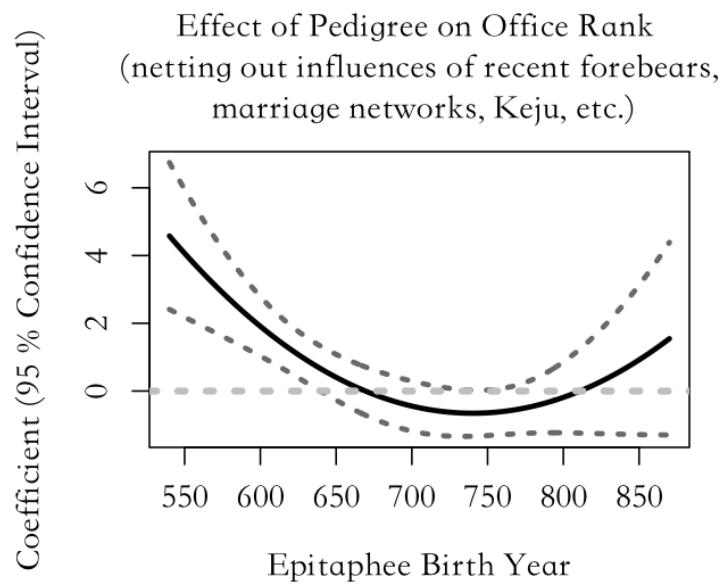
As shown in the left panel of Figure 1, individuals born in the early Tang period (around 550-640) lived in an era when aristocratic pedigree exerted substantial influence on political status. The variable office rank is coded on a continuous scale, with 0 denoting no government position and 18.75 corresponding to the highest first-rank office. At the very founding of the Tang, possession of a prominent pedigree conferred an estimated advantage of roughly 4.5 rank points, equivalent to roughly two full rank categories within the Tang bureaucracy’s nine-rank system. Note that although the proportion of Guanlong aristocrats was relatively high at the early Tang, the multivariate statistical model has already netted out the effects of the recent forebears of meritorious founding elites and the twin-capital marriage network, as well as the broader Guanlong-group effect. From this perspective, the pedigree effect in the early Tang appears remarkably large.
Yet this effect declined rapidly and began to zero out during the reigns of Emperor Gaozong (唐高宗) and Empress Wu Zetian (武则天) (hereafter “the Gao-Wu period,” ca. 650 to 705 CE). As the left panel of Figure 1 indicates, beginning with the cohort born around 640, family pedigree no longer provided a generally applicable advantage in bureaucratic careers. The estimated pedigree effect continued to decline during the Emperor Xuanzong’s (唐玄宗) reign (712 to 756 CE). Although a modest rebound occurred after the Yuanhe (元和) era, it was not statistically significant at conventional levels. In fact, the effect remains statistically insignificant throughout the post-Gao-Wu period. In short, while family pedigree mattered at the very beginning of the Tang, its political significance eroded rapidly. The overall trajectory thus reflects a transition from the political salience of pedigree to its effective eclipse, with the Gao-Wu period marking the critical turning point.55
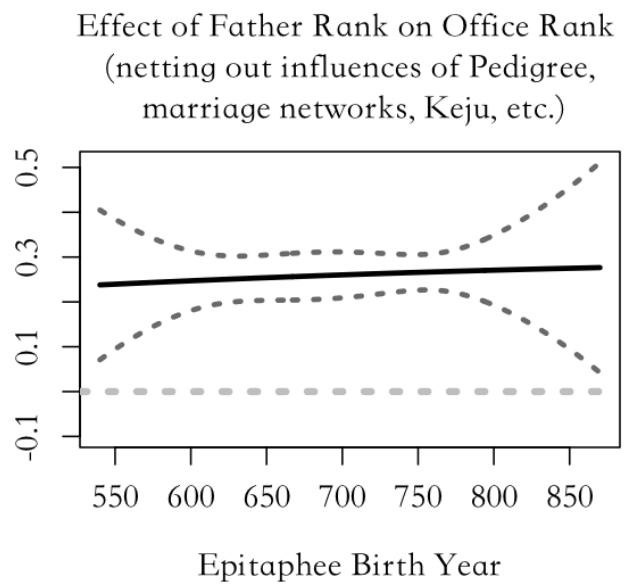
The right panel of Figure 1, on the other hand, shows that the effect of the father’s office rank did not vary substantially over time. From the early through the late Tang, a full one-rank career advancement of the father within the nine-rank system (for example, from Rank Five Principal Lower 正五品下 to Rank Four Principal Lower 正四品下) translated, on average, into an increase of roughly 0.25-unit rank categories for the son (for example, from Rank Eight Junior Lower 从八品下 to Rank Eight Junior Upper 从八品上) within the same system.
The positive intergenerational effect of the father’s office rank remained remarkably stable throughout the Tang, suggesting that the Tang dynasty was not historically “special” in this respect. Across societies and historical periods around the world, one enduring commonality is the important role of paternal support and resources in facilitating children’s success. In this sense, the persistence of paternal influence in the Tang does not distinguish it from other historical or modern societies.
By contrast, many Chinese scholars conceptualize the medieval aristocracy primarily as a social identity grounded in cultural recognition, particularly through ancestral pedigree.56 If the political significance of pedigree is taken as a defining feature of what distinguishes medieval Chinese society, then the sharp contrast in Figure 1 between the rapidly declining pedigree effect and the persistent influence of paternal office rank suggests that, at least in political terms, the Tang dynasty marks a period in which Chinese history became increasingly “de-medievalized.”
I then turn to the net effect of Keju success after accounting for other confounding variables. As shown in the left panel of Figure 2, the net effect of Keju success turns positive during the Gao-Wu period, as the confidence interval no longer includes zero. At this stage, individuals who obtained Keju credentials held final office ranks that were modestly higher than those of non-Keju elites, with the magnitude of the advantage amounting to less than one
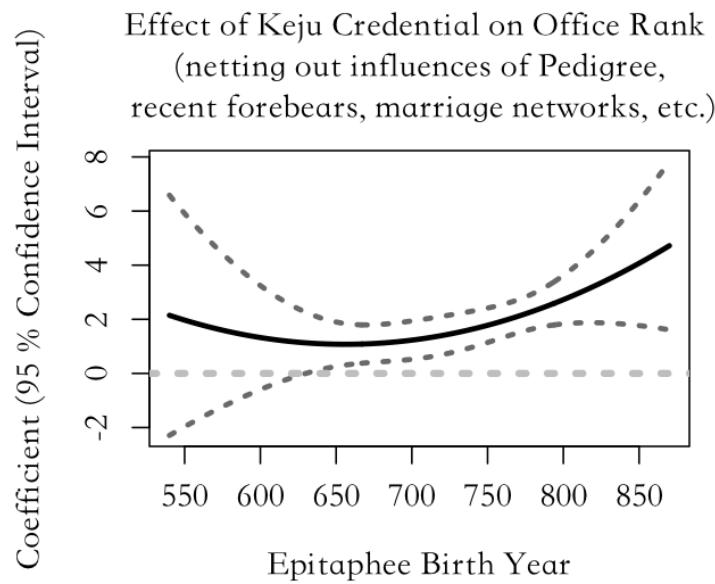
full rank category within the nine-rank system. From the Tianbao (天宝) era (742 - 756 CE, still under Emperor Xuanzong) onward, the effect of Keju success entered a phase of accelerated growth.
Notably, the eras spanning from Gao-Wu to Xuanzong together occupy a central place in Chen Yinke (陈寅恪)’s theoretical framework as a critical juncture in the reconfiguration of social hierarchy during the Tang.57 It provides further validation of Chen’s insight that the effect of family pedigree began to zero out while the effect of Keju took off, precisely among the cohort whose political coming of age coincided with the rise of Empress Wu. By the late Tang, the estimated net effect of Keju success reaches a value of approximately 4 on the rank scale, indicating that the career advantage conferred by Keju had by then become comparable in magnitude to the effect of family pedigree at the early Tang.
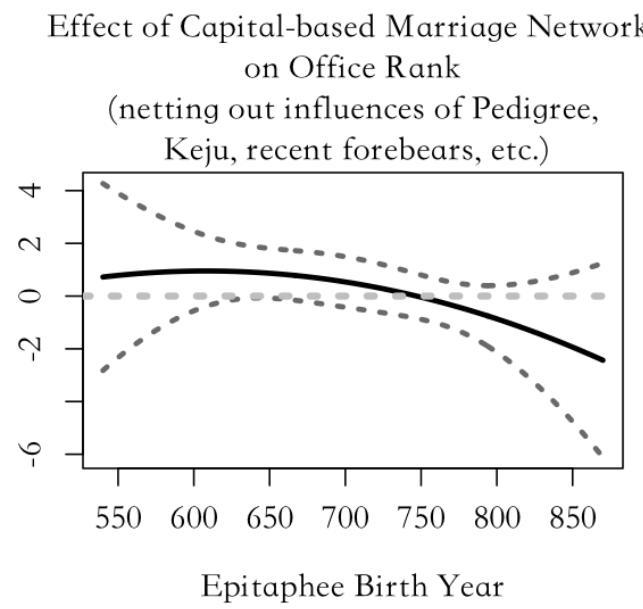
As shown in the right panel of Figure 2, within the tomb epitaph sample, membership in the twin-capital elite marriage network has no statistically significant effect on bureaucratic officeholding. Throughout the entire Tang period, the estimated effect remains close to zero. This non-result essentially overturns the thesis of aristocratic persistence in Destruction and Tackett (2020). Although Tackett claims to rely primarily on tomb epitaph data, applying a more rigorous statistical approach to the same data yields conclusions that point in the opposite direction. Taken together, the two trend plots demonstrate that the rise of Keju and the decline of the aristocracy both occurred well before the Huang Chao Rebellion.
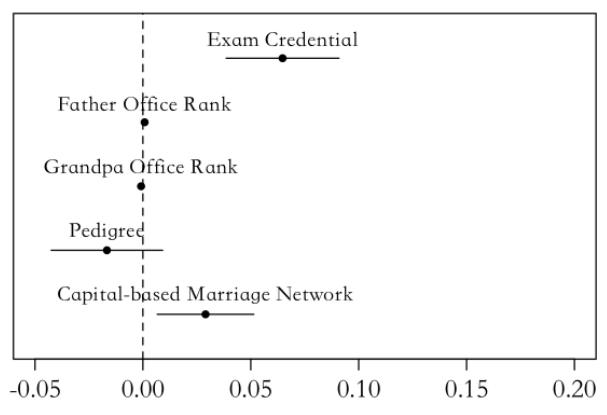
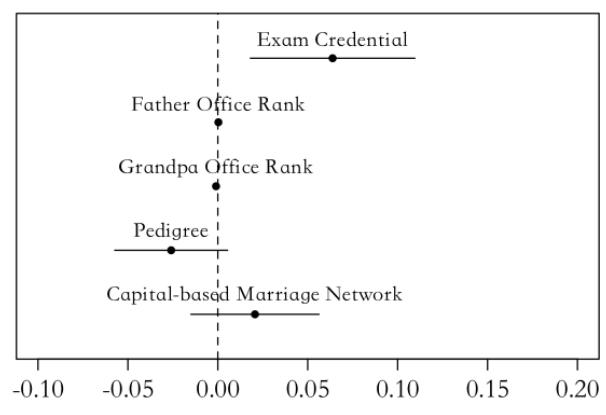
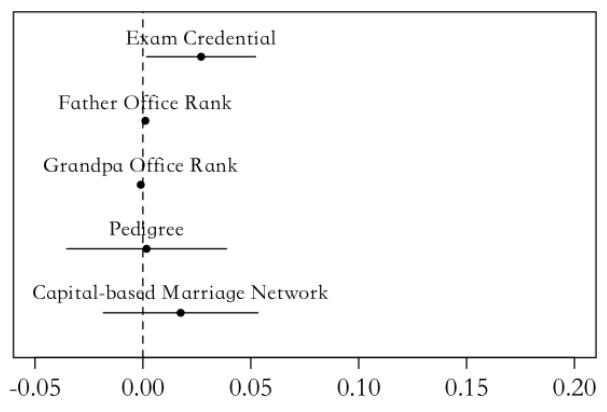
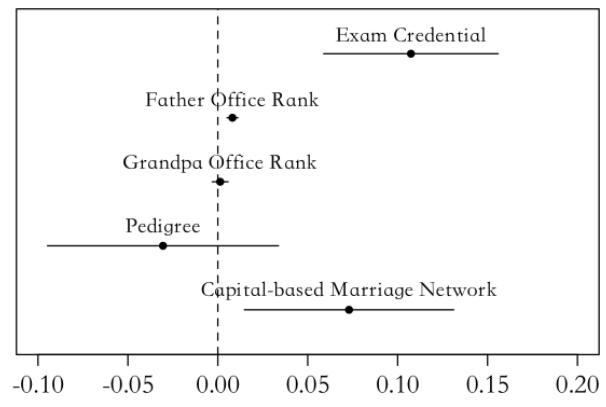
Finally, Figure 3 further illustrates the central importance of the Keju system in the Tang Dynasty. Whether one aspired to become a chief minister, a Hanlin Academian, a finance minister, or a provincial military commissioner, Keju success constituted the single most important channel of upward advancement.58 After controlling for recent forebears, family pedigree, and membership in the twin-capital marriage network, individuals who attained Keju success were 6.5 percentage points more likely to become chief ministers than those who did not. This is a substantial effect given that the average probability of becoming a chief minister in the tomb epitaph sample is only 1.68%.
Similarly, Keju success increases the probability of becoming a Hanlin Academian by 6.3 percentage points, while the average probability of holding such a position in the sample is only 1.17%. This finding corroborates McMullen’s conjecture regarding the close linkage between Keju credentials and appointment to the Hanlin Academy.59
Unlike Hanlin Academians, finance ministers were expected to possess capacities that could not be directly evaluated through Keju exams alone. Even so, our statistical results show that, while the average probability of becoming a finance minister is only 0.916%, individuals who passed the Keju enjoyed a 2.69 percentage-point increase in their likelihood of holding such positions relative to those without Keju credentials.
In the case of provincial military commissioners in the late Tang, the average probability of appointment in the sample is 7.38%; yet Keju success raises this probability by approximately 11 percentage points. This result is consistent with the scholarly observation in studies of Tang provinces that the prevalence of civilian officials serving as provincial military commissioners increased in the late Tang.60
Conclusion
The empirical findings of this study are consistent with, and mutually reinforcing of, a broad body of source-based scholarship on the medieval Chinese aristocracy and Tang history. In particular, the statistical finding that the officeholding advantage associated with aristocratic pedigree rapidly vanished closely mirrors recent research on the Tang phenomenon of manufacturing choronym–surname identities (建构郡望). These two lines of evidence illuminate the same underlying transformation.
In operationalizing pedigree, this study adopts a deliberately strict definition based on affiliation with well-established prominent branches and further validates this measure by demonstrating its strong correlation with Tackett’s twin-capital elite marriage network. This approach substantially reduces the distortion of statistical results caused by the widespread practice of falsely claiming prestigious choronym–surname identities. At the same time, the growing prevalence of such fabricated claims during the Tang dynasty itself points to an intensification of social mobility.62 The proliferation of false choronym-surname claims and the disappearance of the pedigree effect are thus two sides of the same coin. Choronym–surname identities continued to carry social value, which explains why individuals actively sought to associate themselves with them. Yet the political efficacy of pedigree had already eroded. Precisely because elite lineage no longer conferred political advantages, those who genuinely possessed it had little incentive to prevent others from sharing in the symbolic benefits of choronym–surname affiliation.63
Scholarship that treats the aristocracy or great families as a coherent political stratum has largely grown out of studies of the Wei, Jin, and Northern and Southern Dynasties (220 - 589 CE), where such groups indeed constituted a central and politically consequential force.64 By contrast, research on Tang history (618 - 907 CE) has increasingly moved away from a framework centered on aristocratic politics and has instead shifted toward more specific actors, institutions, and issues closely tied to court politics.65 The increasing emphasis on more micro-level perspectives, especially those focused on imperial authority and its dependents, such as court literati (Hanlin Academians), eunuchs, and meritorious elites, further suggests that scholars have implicitly ceased to regard the aristocracy itself as the primary analytical lens for understanding Tang politics. The absence of the aristocracy as a central analytical category in recent historical scholarship of Tang politics thus mirrors the results of my multivariate statistical analysis, which likewise indicate the disappearance of the political advantage associated with family pedigree.
One may also observe a certain tension in classic works on the broad transformations of medieval Chinese history. On the one hand, close examination of specific cases, texts, and institutions consistently reveals a clear trend toward the decline of the aristocracy during the Tang. On the other hand, such arguments must confront the statistical artifact that aristocrats ostensibly constituted a substantial proportion of high-ranking officials throughout the dynasty. Tang Zhangru (唐长孺), for example, argues that “the privileged position of Jinshi degree holders in the Tang replaced that of the earlier aristocracy,” yet he also acknowledges that the aristocracy resembled a force that lingered even after its vitality had ebbed. As he puts it, “at first glance, the Tang still appears to be an age of aristocratic domination, but closer analysis reveals that this was not in fact the case.”66 Yan Buke (阎步克) similarly emphasizes that a series of institutional reforms aimed at strengthening bureaucratization “all indicate that the Tang was no longer a pedigree-based society or a ‘disguised aristocratic society,’” but rather “a competitive, fluid, merit-based bureaucratic order,” in which “the influence of aristocratic pedigree persisted only as a historical residue.” At the same time, Yan was fully aware of the statistical conclusions advanced by the “persistence school” and therefore stressed that “one cannot look only at the people while ignoring the institutions. From the perspective of institutions, what we clearly observe is a process of systematic reconfiguration and transformation. Even from the perspective of people, the former aristocratic elites had already begun to compete for power under the new rules of the game.”67
This study seeks to resolve this tension by arguing that the aristocratic advantage constructed by the “persistence school,” based on statistical analyses of people, may in fact be a data artifact. When addressing macro-historical questions concerning group-level trends such as the decline of the aristocracy or patterns of social mobility, the quantitative approach grounded in statistical analysis clearly offers important advantages. Yet without sufficiently rigorous methods and techniques, quantitative analysis risks falling into statistical pitfalls, often unconsciously. In response, this study revisits the use of the quantitative paradigm in existing research on the medieval Chinese aristocracy, identifying logical flaws at both the conceptual and operational levels. Importantly, however, the limitations of previous studies do not imply deficiencies inherent in the quantitative paradigm itself. Once these problems are corrected through the application of multivariate statistical models that have long been standard in modern social science, we arrive at conclusions sharply at odds with those of “persistence school” scholars such as Mao Hanguang and Nicolas Tackett.
Specifically, the aristocratic advantage in bureaucratic appointment exhibited a gradual decline from the early to the late Tang, while the significance of Keju for social mobility has been seriously underestimated in prior scholarship. In short, when historical data are analyzed using more appropriate methods, the patterns revealed by quantitative evidence largely cohere with the insights long advanced by the majority of historians studying medieval China.
Naturally, the data employed in this study are not without limitations. In recent years, the number of newly excavated and published Tang tomb epitaphs has increased dramatically, far exceeding the coverage of Tackett’s database. The present analysis is therefore intended as a starting point rather than a definitive conclusion. Future research can build on more comprehensive digitization and integration of tomb epitaph materials to further advance our understanding of the Tang aristocracy.
At the same time, statistical methods cannot and should not substitute for close, context-sensitive analysis of specific historical settings and sources. Quantitative approaches yield their greatest value only when integrated with case studies and with careful textual and institutional analysis. In short, research on the medieval Chinese aristocracy—often dismissed as a “traditional” topic—is far from exhausted. On the contrary, it continues to offer considerable scope for renewed inquiry when pursued with new data, refined methods, and sustained engagement between quantitative and qualitative perspectives.
Notes
- 1 “Medieval China” here generally refers to Chinese history from the second to the tenth century CE, encompassing the Eastern Han Dynasty (25 - 220 CE), the Wei-Jin Dynasties (220 - 420 CE), the so-called “Sixteen Kingdoms,” (304 - 439 CE) the North and South Dynasties (386 - 589 CE), the Sui Dynasty (581 - 618 CE), the Tang Dynasty (618 - 907 CE), and the so-called “Five Dynasties and Ten Kingdoms” (907 - 979 CE) era. ↩
- 2 For representative research, see 陈寅恪:《唐代政治史述论稿》,《隋唐制度渊源略论稿·唐代政治史述论稿》,北京:商务印书馆, 2011年;唐长孺:《魏晋南北朝隋唐史三论——中国封建社会的形成和前期的变化》,武汉:武汉大学出版社,1992年;内藤湖南 :《概括的唐宋时代观》,刘俊文主编:《日本学者研究中国史论著选译》第1卷《通论》,黄约瑟译,北京:中华书局,1992年,第 10—18页;Robert M. Hartwell, “Demographic, Political, and Social Transformations of China, 750-1550,” Harvard Journal of Asiatic Studies, Vol. 42, No. 2, 1982, pp. 365-442. Compared with Naitō Konan, Chen Yinke, and Tang Changru, Robert M. Hartwell devoted much more attention to regional patterns of economic and demographic development, yet the decline of the aristocracy remained an integral component of his research. ↩
- 3 See 权家玉:《中古士族研究的推进与展望——近年中古士族研究评介》,《中国魏晋南北朝史学会会刊》第1卷,桂林:广西师 范大学出版社,2020年,第118—137页。 ↩
- 4 范兆飞:《超越个案:士族研究的问题与路径》,《中国史研究动态》2017年第1期,第36页。 ↩
- 5 仇鹿鸣:《失焦:历史分期论争与中文世界的士族研究》,《文史哲》2018年第6期,第119页。 ↩
- 6 I use the terms “statistics,” “quantitative,” and “econometrics” interchangeably throughout this paper. ↩
- 7 孙国栋:《唐宋史论丛》,上海:上海古籍出版社,2010年;David G. Johnson, The Medieval Chinese Oligarchy, Boulder: Westview Press, 1977.; 毛汉光:《中国中古社会史论》,上海:上海书店出版社,2002年;Nicolas Tackett, The Destruction of the Medieval Chinese Aristocracy, Cambridge: Harvard University Asia Center, 2014. ↩
- 8 In recent years, Zhang Tianhong and Sun Jun have also attempted to employ quantitative approaches to examine patterns of social stratification during this medieval era. See 张天虹:《中晚唐五代的河朔藩镇与社会流动》,北京:社会科学文献出版社,2021年;孙 俊:《唐代特权阶层仕宦与社会流动研究》,北京:人民出版社,2021年。 ↩
- 9 陈寅恪:《唐代政治史述论稿》,《隋唐制度渊源略论稿·唐代政治史述论稿》,第183—235页;吴宗国:《唐代科举制度研究》,北 京:北京大学出版社,2010年,第256—260页。 In contrast to Chen Yinke and Wu Zongguo, Peter Bol argues that the Keju not only elevated the social prestige of “civil” (文) (i.e., literary learning and mastery of the Confucian classics) but also eroded the hereditary privileges of aristocratic pedigree by binding the value of “civil” (文) to exam success (Peter K. Bol, “This Culture of Ours”: Intellectual Transitions in T’ang and Sung China, Stanford: Stanford University Press, 1992, pp. 108-147.). David McMullen likewise finds a profound connection between Keju system and the broader social valuation of literary talent. Literary competence, as manifested in exam performance, not only served as a ladder of bureaucratic career advancement but also reshaped the identity of the Tang elite. Through his analysis of the Tang Edict Drafting system—in which the drafting of imperial edicts was integral to nearly all central government actions and required exceptional writing abilities—McMullen demonstrates how literary proficiency emerged as a key mechanism shaping social mobility (David McMullen, State and Scholars in T’ang China, Cambridge: Cambridge University Press, 1988, pp. 225-241.). ↩
- 10 Representative scholars include Sun Guodong, David G. Johnson, Mao Hanguang, and Nicolas Tackett. Although their definitions of the aristocracy vary, they draw similar conclusions. Furthermore, many Japanese scholars in the mid-20th century also reached similar conclusions through comparable methodologies, which I do not list here individually. ↩
- 11 I have previously discussed the “persistence school” (formerly referred to as the “sudden decline school”) and its misunderstandings of Tang-dynasty social mobility in a commentary article in Chinese and a short paper in English. However, many important issues were left unexplored due to limitations in format and space. See Erik H. Wang, “What Quantitative Social Science Can Contribute to History as a Discipline: The Case of the Medieval Chinese Aristocracy,” Academic Monthly, No. 6, 2024, pp. 128-131. [in Chinese]; Fangqi Wen, Erik H. Wang and Michael Hout, “Social Mobility in the Tang Dynasty as the Imperial Examination Rose and Aristocratic Family Pedigree Declined, 618-907 CE,” Proceedings of the National Academy of Sciences of the United States of America, Vol. 121, No. 4, 2024, e2305564121. ↩
- 12 毛汉光:《中国中古社会史论》,第37、145页。It is worth noting that the problem of definitional ambiguity is by no means unique to Mao’s work. For example, an influential statistical study (王伟:《进退之际:唐代士族与科举取士制之关系及其影响》,《北 方论丛》2010年第5期) on the share of aristocrats among those who passed the Keju did not even specify how “aristocracy,” “minor elites,” or “humble families” were defined when presenting its tabulations. ↩
- 13 毛汉光:《中国中古社会史论》,第146、125页。 ↩
- 14 The “choronym” in the choronym-surname combination means an elite’s ancestral hometown or place of origin. For example, Li of Longxi (陇西李氏) or Wang of Langya (琅琊王氏) are typical choronym-surname combinations associated with aristocratic clans, where Li and Wang indicate the clan surnames and Longxi and Langya refer to the ancestral homes (i.e., choronyms). ↩
- 15 毛汉光:《中国中古社会史论》,第36、37、49、50、125页。 ↩
- 16 Nicolas Tackett, “The Evolution of the Tang Political Elite and Its Marriage Network,” Journal of Chinese History, Vol. 4, No. 2, 2020, pp. 277-304. ↩
- 17 Tackett uses the term “network” in both Destruction and his 2020 article. Strictly speaking, however, according to the terminology of Social Network Analysis (SNA), the network-like structure depicted in his figures is not a “network,” but rather the largest component within the network. ↩
- 18 Nicolas Tackett, “The Evolution of the Tang Political Elite and Its Marriage Network,” pp. 277-304. ↩
- 19 Another drawback of this data-construction strategy is that when the defined social network becomes excessively large, its internal cohesion and the sense of mutual identity among its members tend to be very low, making it unlikely for such a group to sustain a distinctive aristocratic culture. See Song Chen, “Review of The Destruction of the Medieval Chinese Aristocracy by Nicolas Tackett,” Harvard Journal of Asiatic Studies, Vol. 75, No. 1, 2015, pp. 233-243. ↩
- 20 《旧唐书》卷 177“史臣曰”,北京:中华书局,1975年,第4620页。 ↩
- 21 Nicolas Tackett, The Destruction of the Medieval Chinese Aristocracy, p. 69. ↩
- 22 Mao Hanguang’s doctoral dissertation explicitly uses “social mobility” in its title, see 毛汉光:《唐代统治阶层社会变动——从官吏家 庭背景看社会流动》,博士学位论文,台湾政治大学政治研究所,1969年。David Johnson likewise uses the term “mobility” when discussing the status of prominent clans (The Medieval Chinese Oligarchy, p. 26). In Tackett’s analysis, social immobility and aristocratic political dominance are two sides of the same coin: “As we shall now see, marriage endogamy also helps to explain the Tang political elite’s remarkable longevity despite avenues of upward social mobility that might otherwise have threatened its monopoly on political power” (Destruction, p. 129, emphasis mine). In context, Johnson’s usage of “advantage” and “privilege” aligns with that of social mobility, both being comparative in nature, pointing to the difference in bureaucratic career outcomes between individuals from different family backgrounds: “high social status was a very great advantage in gaining office,” “A member of an eminent clan was given special advantages in the competition for office” (The Medieval Chinese Oligarchy, pp. 121, 149). Tackett employs the term “advantage” in a similar comparative sense: “Capital elites held a substantial advantage over their provincial peers in this system” (Destruction, p. 133). ↩
- 23 Johnson’s calculated proportion ranges from 56.4% to 62.3%, Mao’s estimate is 64.8%-65.3%, and Tackett’s is 67%-82%. See David G. Johnson, The Medieval Chinese Oligarchy, p. 136; 毛汉光:《中国中古社会史论》,第44—45 页;and Nicolas Tackett, “The Evolution of the Tang Political Elite and Its Marriage Network,” p. 286. ↩
- 24 Walter Scheidel, “Demography,” in Walter Scheidel, Ian Morris and Richard Saller, eds., The Cambridge Economic History of the Greco-Roman World, Cambridge: Cambridge University Press, 2007, pp. 38-86. ↩
- 25 Assuming that each generation in premodern times lasted about thirty years, the 289-year Tang dynasty encompassed at least eight generations. With exponential population growth across generations, for example, two surviving sons per generation would yield 2^8 = 256 male descendants after eight generations. The aristocratic genealogies recorded in the Chancellors’ Genealogical Tables in the New Book of Tang (《新唐书宰相世系表》) often display large, tree-like structures formed through the multi-generational proliferation of an original ancestor who held high office, vividly illustrating the cumulative demographic consequences of natural reproduction across generations. Using a more conservative estimation strategy based solely on tomb epitaph data (which disproportionately represent relatively affluent families; see detailed data below), and defining aristocrats as individuals whose father and grandfather both held office at or above Rank Five Junior Lower (从五品下, the lowest sub-level within the Rank Five category) or whose pedigrees can be traced to prominent branches, one can compare the number of sons recorded in epitaphs to estimate relative offspring survival rates. Even under this conservative approach, the population ratio of aristocrats to non-aristocrats by the end of the Tang is still 2.69 times what it had been in the early Tang. By contrast, the relative stability of the aristocratic share among high-ranking officials is plainly insufficient to match the dramatic expansion of their relative population base. ↩
- 26 This is not to suggest that the aristocratic advantage in officeholding had disappeared entirely at the end of the Tang. After all, aristocrats always constituted only a small fraction of the total population, yet they consistently held a disproportionately large share of government positions; in this sense, they remained overrepresented in the bureaucracy and thus continued to enjoy an officeholding advantage. However, the degree of this overrepresentation declined over time (as the aristocratic population expanded faster than that of non-aristocrats by multiple orders of magnitude), indicating a weakening of the aristocratic advantage. In mathematical terms, the decline in aristocratic advantage could be partially offset by the expansion of bureaucratic offices. Yet there is no evidence that the number of regular office positions within the imperial bureaucracy (流内) even doubled relative to the total population from the early to the late Tang. This point is even clearer given that the “persistence school” bases much of its statistical analysis on the number of chief ministers, which did not change substantially between the early and late Tang, thereby precluding any such offset. ↩
- 27 王德权:《为士之道——中唐士人的自省风气》,台北:台湾政大出版社,2012年,第151—210页;陆扬:《清流文化与唐帝国》, 北京:北京大学出版社,2016年,第225—227页。 ↩
- 28 陈爽:《世家大族与北朝政治》,北京:中国社会科学出版社,1998年,第155—158页。Chen Yinke, for his part, argues that the Tang aristocracy can likewise be divided into two groups: the Shandong old clans, who adhered strongly to ritual norms, and the newly risen ruling elites who relied primarily on the political power of their recent forebears.(《唐代政治史述论稿》,《隋唐制度渊源略论稿· 唐代政治史述论稿》,第259—294页)。 ↩
- 29 See 《旧唐书》卷88《韦思谦传附子韦承庆、韦嗣立传》,第2861—2874页;卷129《张延赏传附子张弘靖传》,第3607—3613页; 卷174《李德裕传》,第4509—4531页;鲍丹琼:《中晚唐吴郡归氏科举家族考——以〈归仁晦墓志〉为中心》,陕西历史博物馆编: 《陕西历史博物馆论丛》第29辑,西安:三秦出版社,2022年,第284—296页。 ↩
- 30 毛汉光:《中国中古社会史论》,第154—155、166页。 ↩
- 31 Nicolas Tackett, “The Evolution of the Tang Political Elite and Its Marriage Network,” pp. 277-304. In addition, scholars such as Han Sheng and Chen Song have also raised doubts about the conceptual validity of the “aristocracy” as constructed by Mao Hanguang and Nicolas Tackett. See 韩昇:《中古社会史研究的数理统计与士族问题——评毛汉光先生〈中国中古社会史论〉》,《复旦学报》2003 年第5期; Song Chen, “Review of The Destruction of the Medieval Chinese Aristocracy by Nicolas Tackett,” pp. 233-243. ↩
- 32 For example, see 孙国栋:《唐宋史论丛》,第300页;王伟:《进退之际:唐代士族与科举取士制之关系及其影响》,《北方论丛》 2010年第5期。 ↩
- 33 The number of successful candidates announced in each Keju examination round during the Tang is drawn from 唐五代进士登科人 名录(张希清等主编,金滢坤著:《中国科举制度通史·隋唐五代卷》附录二,上海:上海人民出版社,2015年,第879—895页). The total figure of 6,585 Jinshi is obtained by aggregating Jin’s reported counts. Since no official Tang-era statistics on total examination admissions have survived via transmitted textual sources, Jin’s estimate itself may in fact understate the true number. Jin also provides the names of known Jinshi graduates for each examination round (including those listed in Dengke Jikao Buzheng (《登科记考补正》)—a modern emended and expanded revision of Dengke Jikao—and those added by Jin himself), totaling 1,594 individuals. In addition, there are 965 Tang Jinshi recorded in Dengke Jikao Buzheng whose specific year of exam success cannot be determined. Although there may exist further Tang Jinshi not recorded in Dengke Jikao Buzheng whose exact years of success remain unidentified, their number is unlikely to be large. Moreover, Jin’s supplementation of such cases relies heavily on Ming- and Qing-period local gazetteers, sources whose reliability for reconstructing medieval society is quite limited. Therefore, this group is not included in my calculation of the total number of Tang Jinshi. Even if all such cases were included, the resulting roster would still represent only a fragmentary portion of the total Tang Jinshi population. Moreover, when mingjing (明经) and other exam subjects are taken into account, the total number of successful candidates during the Tang and Five Dynasties may have exceeded 30,000. Yet as of the publication of Dengke Jikao Buzheng in 2003, the total number of known successful examinees was only about 4,500, representing roughly 15 percent of the estimated total. Although this proportion has likely increased with subsequent discoveries, even a doubling would raise coverage to only around 30 percent. See 徐松撰, 孟二冬补正:《登科记考补正》,北京:北京燕山出版社,2003年;许显华:《〈大唐西市博物馆藏墓志〉所见唐代进士史料》,《赤峰 学院学报》2014年第3期。 ↩
- 34 《旧唐书》卷164《杨於陵传附子杨景复、杨嗣复、杨绍复、杨师复传》,第4294页;卷176《杨嗣复传附子杨技、杨拭、杨㧑传》, 第4561页。 ↩
- 35 For the family background of He Yong, see《唐何邕墓志并盖》,《洛阳新获墓志 二〇一五》,北京:中华书局,2017年,第230页. For the family background of Kang [given name unknown], see 孙樵:《唐故仓部郎中康公墓志铭并序》,《全唐文》卷795,北京:中 华书局,1983年,第8339—8340页. For the family background of Yu Congzhou, see《唐故朝议郎行尚书刑部员外郎会稽余(从周) 公夫人河南方氏合祔墓志铭》,《唐代墓志汇编》大中060,上海:上海古籍出版社,1992年,第2295—2296页. For the family background of Chen Jie, see《唐故中散大夫使持节台州诸军事守台州刺史上柱国赐紫金鱼袋颍川陈(皆)公墓志铭》,《唐代墓志 汇编》贞元130,第1932—1934页;《陈鲂墓志》,《大唐西市博物馆藏墓志》,北京:北京大学出版社,2012年,第992—993页;阙 名:《唐故秀才举颍川陈府君(元造)墓志铭并序》,《全唐文补遗(千唐志斋新藏专辑)》,西安:三秦出版社,2006年,第 297—298页. To be sure, cases in which a successful examination candidate from a non-prominent family later rose to the rank of a prominent official and was selected as the subject of a dynastic biography—thereby retroactively preserving his examination success in the surviving historical records—were exceedingly rare. After all, there is a strong positive correlation between the office rank of one’s immediate forebears and one’s own bureaucratic advancement. For men from families without distinguished recent ancestry (in terms of office-holding), attaining high office within a single generation was by no means easy. Men such as He, Kang, Yu, and Chen were nonetheless able—after passing the keju—to rise gradually to positions such as Director of the Ministry of Justice (刑部郎中), Director of the Bureau of Granaries (仓部郎中), Vice Director of the Ministry of Justice (刑部员外郎), and Prefect of Taizhou (台州刺史), respectively, thus already constitutes clear evidence of social mobility in the Tang dynasty. ↩
- 36 An example in this regard is 王伟:《进退之际:唐代士族与科举取士制之关系及其影响》,《北方论丛》2010年第 5 期. While the difference in the definition of “aristocracy” may partially account for the variation across studies, it is noteworthy that Wang’s article, despite relying primarily on statistical estimates of aristocratic proportions, never offers an explicit definition of what constitutes an “aristocratic” background. Similarly, Sun Guodong, based solely on transmitted textual sources, examines the family backgrounds of only 301 (out of 6585!) successful examinees and concludes that sons of eminent clans and high-ranking officials account for 76.4 percent of the total(《唐宋史论丛》,第 300 页). ↩
- 37 Multivariate statistical modeling has long been an established and reliable method in mainstream research on social mobility. For a literature review of modal quantitative studies, see Michael Hout, “Social and Economic Returns to College Education in the United States,” Annual Review of Sociology, Vol. 38, 2012, pp. 379-400. ↩
- 38 Nicolas Tackett, The Destruction of the Medieval Chinese Aristocracy, p. 139-141. ↩
- 39 See 傅璇琮:《唐代科举与文学》,西安:陕西人民出版社,1986 年,第 381—402页;王炎平:《牛李党争》,西安:西北大学出版 社,1996 年,第 19 页;吴宗国:《唐代科举制度研究》,第 221—222 页。 ↩
- 40 The special Keju test, known as the “decree examination” (制举), was for individuals unwilling to endure the potentially lengthy wait between passing the Keju and starting their bureaucratic careers. This additional exam, offered less frequently, provided a faster path. For example, in 828 CE, Du Mu (杜牧) excelled in the Keju exam at the age of twenty-five, achieving fifth place. He then went on to succeed in the special “decree examination,” securing expedited entry into officialdom. ↩
- 41 《旧唐书》卷177《崔珙传》,第4587—4590页;赵超编著:《新唐书宰相世系表集校》卷2《崔氏》,北京:中华书局,1998 年,第387 页。 ↩
- 42 《唐故登仕郎前守河南府阳翟县尉清河崔(行规)公夫人荥阳郑氏合祔墓志铭》,《唐代墓志汇编》咸通071,第2434页;赵超编 著:《新唐书宰相世系表集校》卷2《崔氏》,第356页。 ↩
- 43 For details on Liu Bin’s family background and bureaucratic career, see 《刘斌墓志》,《大唐西市博物馆藏墓志》,第 710— 711 页。 ↩
- 44 Still taking the bureaucratic career as an example, even if both family background and Keju success matter, we can identify individuals who had nearly impeccable family pedigree, powerful father and grandfathers, and great examination credentials yet still failed to attain the level of office one might expect. Du Mu (杜牧) is a representative case, whose career trajectory may have been shaped by his personal circumstances. For instance, he needed to devote considerable time to caring for his ailing younger brother. Such idiosyncratic factors, which are randomly distributed across individuals in the sample, correspond in multivariate statistical models to the stochastic error term of the regression function. They do not cause bias in the estimation of structural forces; instead, the uncertainty they introduce is reflected in the confidence interval of the parameter estimate through a t-test. For analyses of Du Mu’s bureaucratic career, see 缪钺:《杜牧年谱》, 北京:人民文学出版社,1980年,第79—80页;赖瑞和:《唐代中层文官》,北京:中华书局,2011年,第159—161页. ↩
- 45 Nicolas Tackett, “The Evolution of the Tang Political Elite and Its Marriage Network,” pp. 277-304. ↩
- 46 Of the 5,133 tomb epitaphs whose epitaphees died during the Tang Dynasty, 3,640 pertain to males after excluding eunuchs. In addition to the epitaphees themselves, these male epitaphs also document information on 6,470 fathers and grandfathers. ↩
- 47 As shown earlier in the discussion of the exaggerated aristocratic “advantage” in Keju, this study relies on tomb epitaph evidence precisely because it captures a larger share of mid- and lower-ranking elites whose careers and family backgrounds are rarely documented in transmitted textual sources. Tomb epitaph samples thus play an important role in correcting systematic biases embedded in the traditional historiographical record. ↩
- 48 Before the mid-Tang, eligibility for legal hereditary privileges under the men-yin (门荫) system—in which officials, especially those of Rank Five or above, can secure entry-level bureaucratic appointments for a limited number of descendants simply on the basis of birth—was formally determined primarily by the rank of one’s ceremonial office (散官) rank rather than the formal office rank. In the dataset used in this study, however, ceremonial and formal office ranks are highly correlated, suggesting that the latter can serve as a meaningful proxy for differentiating officials’ treatment and privileges. Moreover, information on the ceremonial office rank is missing for a substantial proportion of the epitaphee’s parents recorded in tomb epitaphs. For these reasons, the empirical analyses in this article rely primarily on the formal office rank rather than the ceremonial one. ↩
- 49 I draw on the following reference works: 吴廷燮:《唐方镇年表》,北京:中华书局,1980年;毛蕾:《唐代翰林学士》,北京:社会科 学文献出版社,2000年;傅璇琮:《唐翰林学士传论》,沈阳:辽海出版社,2005年;《唐翰林学士传论·晚唐卷》,沈阳:辽海出版社 ,2007年;严耕望:《唐仆尚丞郎表》,上海:上海古籍出版社,2007年. In this study, “finance ministers” refers specifically to positions such as the Commissioner of Revenue (度支使) and Salt and Iron Transport Commissioner (诸道盐铁转运使), as compiled and examined in 《唐仆尚丞郎表》. ↩
- 50 Since lineage branches may themselves be retrospective constructions, I restrict the pedigree measure to branches that were already recognized in the early Tang. In historical usage, such branches were referred to not only as “fang” (房), but also as “juan” (眷) or “zhi” (枝). ↩
- 51 柳芳:《姓系论》,《全唐文》卷 372,第 3778—3779 页。 ↩
- 52 For details on the widespread fabrication of choronym-surname identities during the Tang, see 仇鹿鸣:《制作郡望:中古南阳张氏的 形成》,《历史研究》2016年第3期;范兆飞:《祖先光谱:中古士族的谱系与谱牒》,上海:上海古籍出版社,2024年,第177—204 页。 ↩
- 53 Taking the Duke of Yue (越公) branch of the Yang of Hongnong (弘农杨氏) as an example, whether this branch’s Northern Dynasties ancestors genuinely belonged to the Yang of Hongnong is a question of real significance for the study of Northern Wei aristocracy. For the study of the Tang aristocracy, however, this issue is of limited importance, because in the Tang period, the Duke of Yue branch had already been socially recognized as an established prominent branch of the Yang of Hongnong. The authenticity of its earlier genealogy thus bears little relevance for analyzing the Tang aristocratic elite. For details on the process by which the Yang family of Yang Bo (杨播) in the late Northern Wei manufactured a Hongnong choronym-surname identity through fabricated genealogy and the establishment of estates and burial grounds in Huayin, see 黄桢:《制造乡里:北魏后期的弘农习仙里杨氏》,袁行霈主编:《国学研究》第36卷,北京:北京大学 出版社,2015年,第255—276页。 ↩
- 54 For example, an individual born in 658 CE is coded as 650 on this variable, while one born in 661 CE is coded as 660, reflecting decade-based grouping. ↩
- 55 This empirical finding broadly aligns with Chen Yinke’s canonical view that, since the Gao-Wu period, the political standing of the old Shandong aristocratic families increasingly came under challenge from newly emerging ruling groups(《唐代政治史述论稿》,《隋唐制 度渊源略论稿·唐代政治史述论稿》,第261页). ↩
- 56 仇鹿鸣:《失焦:历史分期论争与中文世界的士族研究》,《文史哲》2018年第6期。 ↩
- 57 陈寅恪:《唐代政治史述论稿》,《隋唐制度渊源略论稿·唐代政治史述论稿》,第183—235页。 ↩
- 58 Because the three major delegated commissions, namely Hanlin Academician, finance ministers, and provincial military commissioners, were concentrated primarily in the mid- and late Tang, I do not trace temporal change from the early to the late Tang but instead focus on the average effect in the mid- to late-Tang period. ↩
- 59 David McMullen, State and Scholars in T’ang China, 1988, pp. 237-241. ↩
- 60 This pattern appears to be particularly pronounced in fiscally affluent southeastern Tang provinces, see 张国刚:《唐代藩镇研究》,北 京:中国人民大学出版社,2009年,第58页。 ↩
- 61 In statistical analysis, an estimate (typically referring to a point estimate) and its confidence interval together constitute a complete description of an unknown parameter. In Figure 3, each “dot” represents the estimated effect of a given variable (e.g., the effect of Keju success on the probability of becoming a chief minister), and the “horizontal line” indicates the corresponding confidence interval. ↩
- 62 For examples, 仇鹿鸣:《制作郡望:中古南阳张氏的形成》,《历史研究》2016年第3期;范兆飞:《祖先光谱:中古士族的谱系与谱 牒》,第177—233页。 ↩
- 63 After the demise of the Nine-Rank Rectifying System (九品中正制), the Tang state also had little incentive to police legally binding boundaries between social strata. ↩
- 64 In addition to the above-cited 陈爽《世家大族与北朝政治》, see also 田余庆:《东晋门阀政治》,北京:北京大学出版社,1996年; 仇鹿鸣:《魏晋之际的政治权力与家族网络》,上海:上海古籍出版社,2012年。 ↩
- 65 In addition to the above-cited 陆扬《清流文化与唐帝国》, see also 任士英:《唐代玄宗肃宗之际的中枢政局》,北京:社会科学文 献出版社,2003年;黄永年:《六至九世纪中国政治史》,上海:上海书店出版社,2004年;张耐冬:《太原功臣与唐初政治》,北京: 中国社会科学出版社,2018年;黄楼:《神策军与中晚唐宦官政治》,北京:中华书局,2019年。 ↩
- 66 唐长孺:《魏晋南北朝隋唐史三论——中国封建社会的形成和前期的变化》,第400、402页。 ↩
- 67 阎步克编著:《波峰与波谷:秦汉魏晋南北朝的政治文明》,北京:北京大学出版社,2017年,第8页。 ↩